Six lessons on the financial crisis that help explain why we’re still in one.

Six lessons on crisis that help explain why we’re still in one:

  1. When you don’t reinvent institutions at a time of systemic failure, the problems they’re creating don’t just magically disappear.
  2. When you prop up (read: bail out) the institutions causing the crisis, instead of reinventing them, the crisis will deepen.
  3. When dysfunctional institutions prop one another up, prosperity’s a house of cards. Crisis becomes stagnation.
  4. When propping up failed institutions has drained your resources, you’ve turned a crisis into a catastrophe.
  5. The longer it takes you to see a crisis for what it truly is, the disproportionately worse it’s likely to get.
  6. When people who are prisoners of the

a post capitalism look at how to run the business of life

Read more

Whodunit? Great books on the causes and solutions to the Financial Collapse

February 1, 2012 by · Leave a Comment
Filed under: The Economy and Current Affairs 

A year ago for Christmas I received a Kindle eReader (thank you Tammy!) and it has greatly accelerated my consumption of books. One of the subjects that I dove (continued to dive) into was the causes of the financial collapse. The conditions that contributed to our undoing, how we get out of our ongoing mess and the steps that should be taken to prevent a repeat are vitally important to our future as well as to our children and their children.

Learning from History

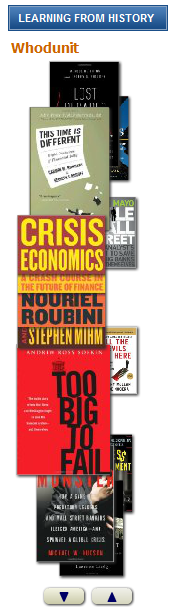
I have written about this myself since 2008 (see here and here for instance) and have read a number of books on the subject (see my Whodunit list down to the right on this page under Learning From History) that I thought covered fairly well the breadth of the subject and helped me refine my understanding. However I was humbled last night by a blog post on The Baseline Scenario that linked to Reading About the Financial Crisis: A 21-Book Review by Andrew Lo, a truly epic undertaking that is well worth reading on its own.

The causes are Read more

Mauldin: Mayan Calander predicts end of Europe… not world. Whew, good thing we’ll be ok- or not

January 17, 2012 by · Leave a Comment
Filed under: The Economy and Current Affairs 

Gallows humor for sure. The article is the best explanation of Europe’s predicament in layman’s terms I’ve read. See the article here: The End of Europe?

Is a Gold Standard the Answer to Our Monetary Crack-Up?

January 14, 2012 by · Leave a Comment
Filed under: The Economy and Current Affairs 

My brother Tom shared an article from the Cato Institute entitled: “Why Gold-Defined Money Is the Answer to Our Monetary Crack-Up”.

I agree with the writer in theory but as Yogi Berra said: In theory, there is no difference between theory and practice. In practice, there is. A couple points:

With a fixed currency like a gold standard innovation and value creation that grows the economy will be constrained and what growth does occur will cause prices to fall, hurting the producers of goods and limiting real returns to their investors. There has to be some mechanism to grow money supply at the approximate rate of real growth in the economy.

The real problems we’re facing around the world are from excess leverage and at the end of every debt binge the unwinding happens in three ways.  Debt creation can be reduced and austerity can be imposed to make room for Read more

5 signs we’re not heading into Depression 2.0

October 17, 2008 by · Leave a Comment
Filed under: The Economy and Current Affairs 

In a series of emails with Vince Farrell, CIO of Soleill Securities we were discussing his comments on CNBC about the contrast between 1929 and now. His point was that the policy decisions being made now are the correct ones and that there are a number of protections in place, as a result of the depression, that will prevent this recession from becoming a depression.

Briefly here are Vince’s points that are both necessary steps to preventing depression and signs of hope for the future:

On World Trade-
Then: Smoot Hawley Tariffs enacted, result, world trade falls by two-thirds (66%!)
Now: During the last G7 meeting, members agree to “do no harm” in terms of protectionism. Read more