What is Money? There’s more to it than meets the eye. From GK Research via David Hay over at Evergreen Capital Mgt.

March 10, 2012 by · 3 Comments
Filed under: The Economy and Current Affairs 

Great exploration of what money is and what it requires to remain viable. The piece covers such topics as:

  • The original philosophical difference
  • Does money need political backing?
  • Money as a common good
  • Money as an information system
  • Differentiating between money and credit
  • The costs of money
  • The external price for money—or the exchange rate
  • Money in a non-democratic society
  • The gold standard
  • Read more

Multifamily is best Commercial RE sector but…. Video from Starpoint CEO Paul Daneshrad

Bad Economic Theory caused the financial collapse along with greed, corruption and leverage says new book

February 20, 2012 by · Leave a Comment
Filed under: The Economy and Current Affairs 

Last week in Economists Prove Einstein’s Theory About Repeating Behavior And Expecting Different Results I was talking about how mainstream economists have earned their dismal reputation because I’ve been searching for a better model of how the economy actually works. Now a new book explains just how the current mainstream economic theory of ‘Rational Expectations’ not only is wrong but in fact is one of the leading causes of the financial collapse. Better yet the author explains why the new economic model which is based on game theory is better  for understanding the financial world but additionally offers a way to avoid future collapses.

American Gridlock: Commonsense Solutions to the Economic Crises

I have read in numerous places recently about how the profession of economics has failed to deliver real benefits because the mainstream theory is built on the wrong assumptions. I and I’m sure you also have experienced the downside of this but these pieces until now have only been able to point out the problem not the solution which would be a new model of the economy and what it would teach us to do differently. Well now we have a better model and what needs to be done to move Read more

Canadian office, industrial and retail Real Etate on fire too. Not just multifamily.

February 20, 2012 by · Leave a Comment
Filed under: Commercial Real Estate 

see the CNW article here: Strong performance in Canadian real estate continues

When long time contrarians flip is that confirmation of a market top? What about in multifamily?

Read this week that well known stock market perma-bears have gone bullish and that struck a nerve in my contrarian’s contrarian heart. This morning I read a post on the Joseph Bernard Investment Real Estate blog that really got my attention.  Here’s what stopped me in my tracks:

In three decades working in and ­studying multifamily, Johnsey, president of Dallas-based research firm Axiometrics, has developed a bias toward an outlier’s view of what’s happening and what’s coming next. This time, though, it’s different. Strangely, he’s finding no counterpoint position to argue.

“Everything is just ripe for a robust apartment market,” Johnsey says. “I’m always looking for problems. But these numbers are just some of the strongest I’ve seen.”

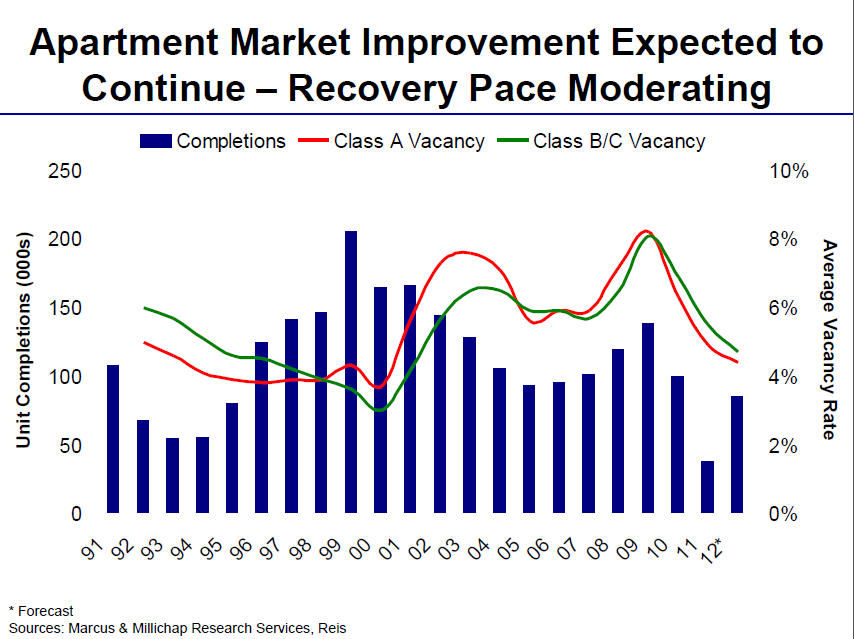
Johnsey has company aplenty. Market researchers, Wall Street analysts, REIT executives, big multifamily players, and small alike can scarcely quell optimism over practically a sure bet for a bountiful 2012. [Emphasis mine]

Regular readers and students of the financial collapse will instantly recognize the first highlight as echoing the title of probably the best book ever written on the subject, “This Time Is Different: Eight Centuries of Financial Folly”. Authors Rogoff and Reinhart have researched and written (exhaustively) about how many times that sentiment has proven exactly wrong. If you haven’t read it, check it out on Amazon by clicking on the book image in the ‘Learning From History’ section on the right of this page.

Granted the rest of the article goes on to lay out the great fundamentals the national apartment market is currently enjoying and further that short of institutional grade properties in core markets multifamily is a very local business (and properties are more reasonably priced). But still…

What are you seeing in your market?

Amazon is building a 3M square-foot campus of office towers in Seattle

More jobs = more renters, good for multifamily. See the piece here: Amazon is building a 3m campus of towers

Economists Prove Einstein’s Theory About Repeating Behavior And Expecting Different Results.

February 16, 2012 by · 2 Comments
Filed under: The Economy and Current Affairs 

Mainstream economic theory (MsET) has two fundamental tenets that most thoughtful people (even economists) realize are wrong and yet economic decisions and importantly even Fed policy is still based on this flawed model. We know what Einstein said this defines and it’s true.

Problem #1 is the Efficient Market Theory (EMT) or Theory of Rational Expectations says that economic information is widely distributed and that we as individuals and collectively as a market of decision makers and consumers consistently make our choices based on what will give us the most benefit. This has been scientifically proven to be not the case way more often than we like to think. For more on this see “Predictably Irrational” by Dan Ariely and “Thinking, Fast and Slow” by Kahneman in the ‘On Our eReaders Now’ box in the far right column of this page.

The second problem is that MsET is built on the idea that the economy tends to be stable and that dislocations are temporary and tend to correct themselves back to stability somewhat like a train running down the tracks that gets thrown off from time to time. History teaches us that is not the case either. Most often we are moving away from or back towards stability and occasionally pass through stability but typically overshoot. It doesn’t take much imagination to see how these two errors cause problems for economists (and us) and leads to a dismal reputation for them.

I’ve been reading a lot on economics lately searching for a new improved model and have just found a number of articles that tackle those issues. They are lengthy but well worth the reads. The first two were posted by John Mauldin in his ‘Outside The Box’ (OTB) series where others write about and discuss their sometimes opposing views from John’s. Mauldin will begin each piece with an intro about the author and where he might differ from that point of view. His guests are typically people who deal at the highest levels and their insights are Read more

Why it’s good news that more Americans are renting rather than buying homes. Via Slate. Good for #Multifamily

Exec Sum:

The American economy is making a significant shift from buying to renting, and that may ultimately be good news. According to a USA Today analysis of Census data released this weekend, since 2006, the number of households that rent has grown by about 700,000 a year, while the number of households that own has fallen by about 200,000 a year.

[R]enting is better than owning for many Americans. Indeed, dozens of recent studies have shown that, excepting the go-go bubble years, houses tend not to make very good investments at all: A prospective homebuyer would have made more money taking her down payment, parking it in inflation-adjusted Treasury bonds, and renting.

But it is conclusive: Not everyone should own a home. The recession has helped erode the stigma against renting, with about 70 percent of Americans now admitting that it has advantages over buying a house. If people are making unsentimental decisions about whether homeownership is really worth it for them, that is at least one small benefit of the housing bubble bursting.

See the whole article with links to reports and surveys here: The Rent Isn’t Too Damn High

Zero Bound Interest Rates, The Zirp Dimension, Stagflation and #Multifamily

Zero interest rates and apartment building investment.

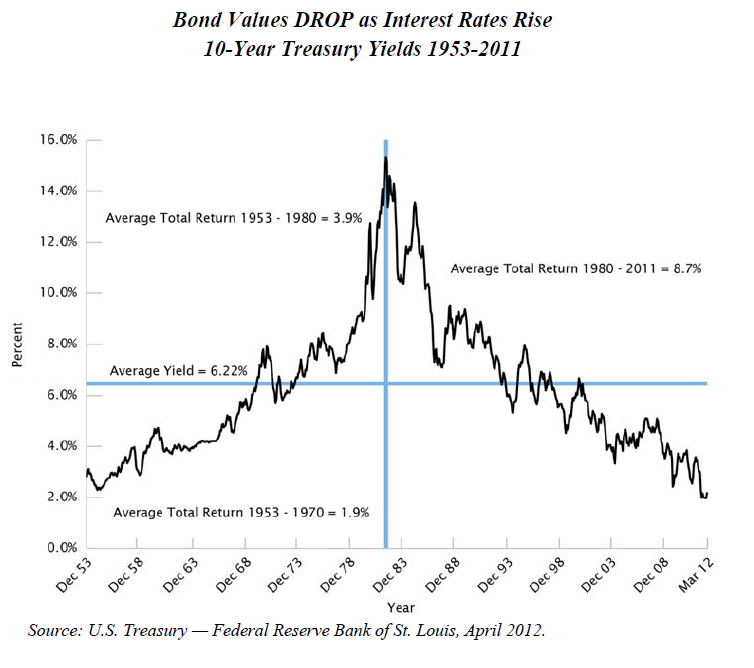
First my condolences to Bill Gross on the loss of his brother-in-law. Reading his piece in PIMCO’s latest Investment Outlook it is clear that the world’s biggest bond manager is running out of places to generate returns for their investors and by extension this applies to all income investors, especially retired people trying to live on interest income. For those would like to retire soon you may have to delay that decision for “an extended period’ as Edward Harrison over at Credit Writedowns put it in Permanent Zero and Personal Interest Income.

Gross’ points out that the Fed’s zero interest rate policy (ZIRP) which they have just announced to maintain through 2014 and their defacto though opaque continuation of quantitative easing (QE2.5 as he tweeted it) threaten to take us into another dimension where their policies have the opposite effect of their intentions.

“Much like the laws of physics change from the world of Newtonian large objects to the world of quantum Einsteinian dynamics, so too might low interest rates at the zero-bound reorient previously held models that justified the stimulative effects of lower and lower yields on asset prices and the real economy.” – Bill Gross

His bullet points:

  • ​ Recent central bank behavior, including that of the U.S. Fed, provides assurances that short and intermediate yields will not change, and therefore bond prices are not likely threatened on the downside.
  • Most short to intermediate Treasury yields are dangerously close to the zero-bound which imply limited potential room, if any, for price appreciation.
  • We can’t put $100 trillion of credit in a system-wide mattress, but we can move in that direction by delevering and refusing to extend maturities and duration.

For more views on this and Europe too see also Entering the Debt Dimension from Phil’s Picks on the Phil’s Stock World Blog.

What does this mean for Multifamily?

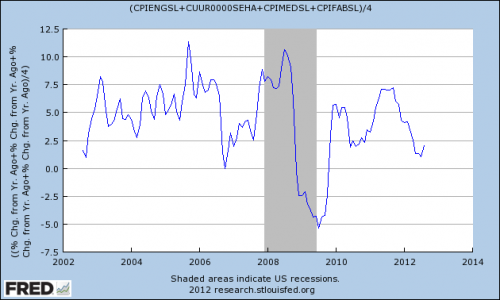
The Zirp Dimension leads to Stagflation where economic growth remains anemic yet prices on essential Read more

Find the freight trains in your life and get on them instead of in front of them.- Barry Sternlicht Video via @Michael_MBA

Great advice from Barry Sternlicht plus much, much more on real estate, investment, capital, leadership, opportunity, Europe, China while speaking at the Schack real estate conference. He is one very smart guy while being personable and humble, a  rare but valuable combination. Reminds me a bit of my virtual mentor Tom Barrack, and not just because of the haircut! Barry even mentions wanting to learn how to surf, something Tom could definitely help with.

Here’s the link to the video: Barry Sternlicht at Schack RE Conference For more great video from the conference Read more

« Previous PageNext Page »